Welcome to visit the website of HJ Polymer China Co., Ltd. ---Semi-conductive Compound Industry Solutions


 中文简体
 Français
 عربى


Welcome to visit the website of HJ Polymer China Co., Ltd. ---Semi-conductive Compound Industry Solutions

Content
Copper is the conductor of choice for many MV and HV cables because it combines conductivity with mechanical robustness. Yet the same metal can become a quiet troublemaker at the semiconductive shield interface. When copper, heat, oxygen, moisture, and electrical stress meet, copper ions can accelerate polymer oxidation. The result is not always dramatic at first: embrittlement, microcracks, adhesion drift, or voids may take months to appear. Copper-stabilized insulation shield compounds are designed to interrupt that chain. They combine a clean polyolefin base, conductive carbon black, and a stabilizer system selected to tolerate copper contact. At HJ Polymer, we have spent years formulating semiconductive compounds for cable shields, and the practical lesson is simple: copper protection is a system property, not a single additive. For broader background, see our guide to power cable semiconductive compound composition, performance and selection.
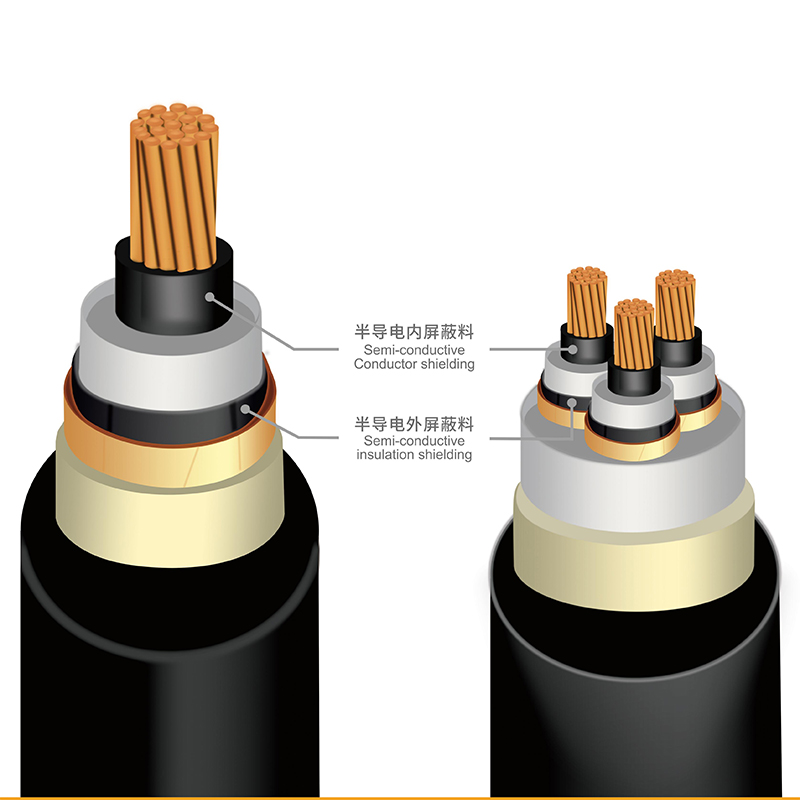
Copper degradation in cable shields usually begins at interfaces. On the conductor side, the conductor shield is in direct contact with copper. On the outer side, an insulation shield may touch copper tape or copper wire screen. Even when direct contact is limited, copper ions can migrate under heat and moisture. In polymer aging, copper ions help break down hydroperoxides, which accelerates carbonyl formation, chain scission, and embrittlement.
In a semiconductive compound, the consequences can be subtle. A shield may become brittle or develop microcracks. Its surface may adhere too strongly to insulation, making stripping difficult, or it may lose adhesion in an uncontrolled way. Local voids and contamination can concentrate electrical stress, and in wet service, moisture plus ionic species may encourage water treeing. These effects rarely appear in a single short test, which is why copper-stabilized formulations are evaluated with aged samples and interface-sensitive methods.
“Copper-stabilized” does not mean adding copper to the compound. It means the compound’s stabilization package is designed to resist copper-catalyzed degradation. In our experience, a robust package usually combines a primary antioxidant, a secondary antioxidant, an acid scavenger, and a metal deactivator. The metal deactivator chelates copper ions and reduces their catalytic activity. The acid scavenger neutralizes acidic byproducts. Primary and secondary antioxidants work at different stages of the oxidation cycle. The carbon black also matters: its surface chemistry, ash content, and ionic cleanliness influence how the compound behaves at an interface.
Formulation balance is just as important as additive selection. A heavy stabilization package can improve oven aging but hurt strippability or increase moisture sensitivity if the additives are not compatible. The best copper-stabilized shield compound is the one that meets the cable design, the processing line, and the end-use environment together.
For medium-voltage cables with copper conductors, a dedicated conductor shield grade can simplify this balance. Our HJ0305 is formulated as a semiconductive conductor shielding compound for MV power cables in copper-related applications.
 HJ0305 Copper-Resistant Conductor Shielding Compound for MV CablesSemiconductive conductor shield grade with copper oxidation resistance, stable volume resistivity, and thermal stability for extruded MV power cables up to 36 kV.View Product →
When customers ask us how to choose a copper-stabilized insulation shield compound, we start with the cable rather than the datasheet. The cable construction tells you where copper contact occurs, what temperature the shield will see, and how the cable will be installed. The processing line tells you how much shear and heat the compound will experience. The test plan tells you which failure modes matter.
It also helps to discuss stripping behavior early. Bonded and strippable shields solve different cable-making and field-installation needs; our note on bonded and strippable MV conductor shield standards explains how those choices interact with material design. Ask for aged data, interface data, and processing recommendations for the actual line.
No single test tells the whole copper-stabilization story. A practical program combines accelerated aging with interface inspection. Oven aging of tensile bars gives a first look at oxidative stability. Copper-contact aging, where the compound is exposed to copper under controlled heat, is more directly relevant. Moisture aging and wet electrical tests are important for cables that will see humid service.
At the interface, surface smoothness and cleanliness deserve attention. A shield surface that looks acceptable under low magnification may still contain gels, agglomerates, or contamination that concentrate stress. Extrusion trials should include screens and filtration checks. Stripping tests should be run on finished cable constructions, not only on plaques. For a copper-stabilized insulation shield, we also look at adhesion after aging. A compound that strips cleanly when new but bonds tightly after thermal aging may create field problems.
| Risk area | What may happen | Design or processing response |
|---|---|---|
| Copper-catalyzed oxidation | Embrittlement, cracking, and loss of mechanical integrity near the interface | Use a balanced antioxidant and metal deactivator package; verify with copper-contact aging |
| Ionic contamination | Higher leakage, unstable interface behavior, and moisture sensitivity | Select clean carbon black and raw materials; control handling and filtration |
| Adhesion drift | Stripping difficulty or uncontrolled release after aging | Design the strippable or bonded system for the cable construction; test aged finished cable |
| Dispersion defects | Gels, agglomerates, and surface roughness that concentrate stress | Match melt flow to the line; use appropriate screw design and screen pack; inspect extrudate |
| Moisture exposure | Water treeing and interface degradation in wet service | Use hydrolysis-resistant base polymers and compatible additives; run wet aging tests |
Copper stabilization is not a universal add-on. An insulation shield for a copper tape or wire screen has different exposure than a conductor shield pressed against a stranded copper conductor. In a medium-voltage cable, the insulation shield must also protect the insulation interface, remain clean, and strip or bond as specified. That is why we offer application-specific versions rather than a single “copper” grade for every position.
For MV insulation shielding where copper contact is part of the design, our HJ0605 copper version is intended to support that combination of conductivity, aging resistance, and interface behavior.
 HJ0605 Copper-Resistant Strippable Insulation Shielding CompoundStrippable semiconductive insulation shield for copper tape systems, designed to inhibit copper oxidation and support stable electrical performance in MV cables up to 36 kV.View Product →
For high-voltage constructions, the same principles apply but the tolerances tighten. Cleanliness, smoothness, and consistency become more critical because electrical stress is higher. A compound that performs well in a 10 kV or 35 kV cable may not be suitable for a 220 kV design without a different raw material strategy, filtration package, and quality plan. We evaluate each case against the cable design and the customer’s test protocol rather than assuming that a higher voltage label alone defines performance.
A copper-stabilized claim should be backed by routine control, not only a formulation sheet. Incoming raw materials need consistent ionic cleanliness and additive activity. Carbon black needs stable surface chemistry and dispersion behavior. Finished compound should be checked for melt flow, density, tensile properties, and surface quality. For critical projects, we add copper-contact aging and interface tests to the control plan.
Our production experience has taught us that small changes matter. A new carbon black lot, a different antioxidant carrier, or a longer residence time in the extruder can shift the balance. The response is not to overcomplicate the specification but to identify the few variables that truly affect copper-related degradation. Then control them consistently. That is how a compound earns trust in the field: not by one dramatic test result, but by repeatable behavior across lots, lines, and cable designs.
Copper does not have to be the weak point in a power cable. With the right stabilization package, clean raw materials, and interface-focused testing, a copper-stabilized insulation shield compound can resist copper-related degradation and support long cable life. We welcome technical conversations about your construction, line, and test requirements. The most useful starting point is usually a clear description of where copper sits in the design and what the finished cable must prove.