Welcome to visit the website of HJ Polymer China Co., Ltd. ---Semi-conductive Compound Industry Solutions


 中文简体
中文简体 Français
 عربى
عربى

Welcome to visit the website of HJ Polymer China Co., Ltd. ---Semi-conductive Compound Industry Solutions

Content
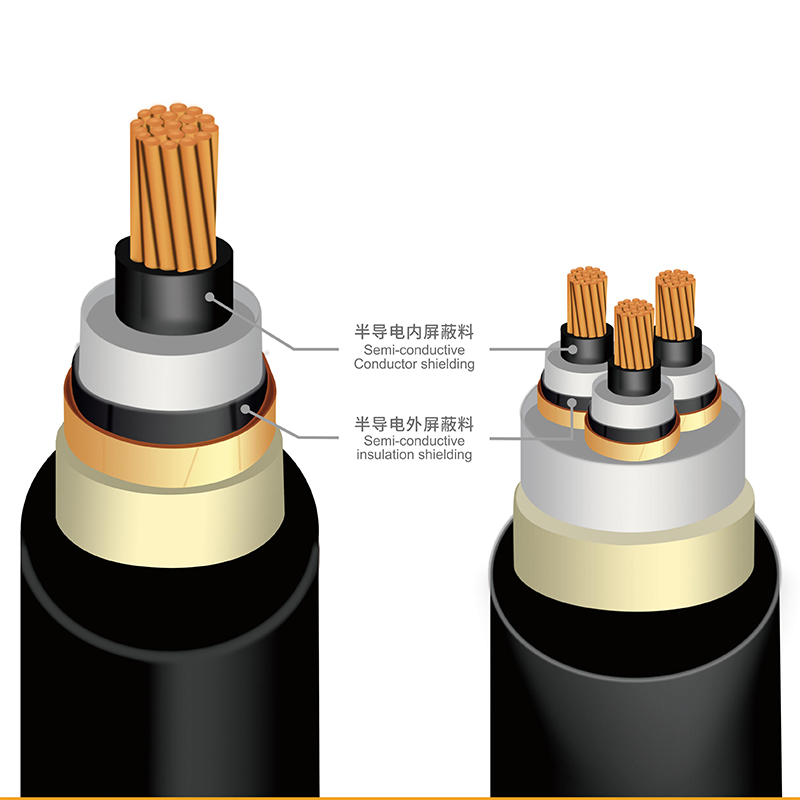
Strip back the insulation on a medium-voltage cable and the first thing you'll find underneath the conductor's outer surface isn't insulation at all — it's a thin, black, semi-conducting layer extruded directly over the stranded conductor. This is the conductor shield, sometimes called the strand shield, and it's a distinct material with its own set of requirements, separate from the insulation shield that sits on the outside of the insulation.
Its function is narrow but critical: eliminate the electrical stress concentrations that would otherwise form at every gap between conductor strands. A bare stranded conductor is geometrically irregular at a microscopic level, and irregularity under high voltage means uneven field distribution. The conductor shield smooths that out, presenting the insulation with a clean, cylindrically uniform surface to bond against.
Because it sits at the innermost, highest-stress point in the cable's cross-section, this layer gets less forgiveness for defects than almost any other material in the construction. A void or protrusion here sits closer to the highest field gradient in the cable than the same defect anywhere else.
MV Cable Conductor Shield Compounds fall into two broad categories based on how they interact with the insulation layer above them. Bonded shields form a strong, essentially permanent adhesive bond with the insulation, which maximizes the integrity of that interface and minimizes the risk of voids forming at the boundary over time.
Strippable shields are formulated to release cleanly from the insulation when a technician needs to prepare a cable end for a splice or termination. This isn't a lesser material — it's a different additive package, often including a controlled release agent or a resin system chosen specifically to limit adhesion strength to a target range that's low enough to strip by hand but high enough to prevent field-induced separation during service.
The choice between the two isn't purely a material decision. Utilities and industrial users who do frequent cable repairs or terminations in the field often specify strippable shields to reduce installation labor, while applications where the cable will rarely if ever be re-terminated may favor the stronger interface integrity of a bonded system. Getting this specification wrong doesn't cause immediate failure, but it does create friction — either splicers fighting an interface that won't release, or a bond that's weaker than the application actually needed.
Most conductor shield compounds are built on a polyolefin base — ethylene vinyl acetate copolymer with a relatively high vinyl acetate content is common, chosen partly because its polarity improves compatibility with conductive carbon black and partly because it supports the peroxide cross-linking systems used in thermoset shield layers.
Conductive carbon black is dispersed through the resin at a loading high enough to bring volume resistivity into a working range, typically cited between roughly 10⁻¹ and 10⁸ ohm-cm on a finished cable construction. Getting resistivity into range is only half the job — the carbon black also has to stay uniformly dispersed through repeated thermal cycling over the cable's service life.
Rounding out the formulation, an organic peroxide handles cross-linking, and for strippable grades a strip-force reduction aid (nitrile rubber is a common choice) is blended in to control adhesion. Processing aids and antioxidants round out the package, much as they do in insulation shield compounds, though the specific ratios differ because a conductor shield doesn't need to match the insulation's dielectric properties — only its physical interface.
ANSI/ICEA S-94-649 is the primary reference standard for conductor shield materials on concentric neutral cables rated 5 through 46 kV, setting void and protrusion limits along with minimum thickness requirements at any point along the shield. AEIC CS8 covers similar ground for utility-grade cable and is frequently referenced alongside ICEA specifications in cable purchase specifications.
These standards don't just set a pass/fail bar for finished cable — they effectively define what "acceptable" carbon black dispersion and extrusion quality look like for the compound itself, since void and protrusion counts are a direct readout of how well the compound was mixed and processed. A compound that consistently meets these limits under production conditions, not just in a lab sample, is what separates a reliable supplier from one whose datasheet numbers don't hold up on the line.
Some specifications also call for a "super-smooth" grade of conductor shield, used in higher-voltage or more demanding applications where standard smoothness tolerances aren't tight enough. This isn't a different chemistry so much as a tighter dispersion and processing target applied to the same base formulation family.
Water treeing is a slow degradation mechanism unique to polymer-insulated cables operating in wet or buried environments. Microscopic channels — the "trees" — grow through the insulation over years, typically starting at a defect or contamination point near the conductor shield or insulation shield interface, eventually connecting into a path that triggers electrical failure.
Because the conductor shield interface is where trees most often initiate, the quality of that interface has an outsized influence on cable service life. This is why conductor shield compounds are evaluated using the Accelerated Water Treeing Test (AWTT), which subjects a cable sample to elevated voltage and moisture to compress years of aging into a manageable test period.
A compound that performs well in AWTT testing isn't necessarily one with different base chemistry — it's usually one with cleaner carbon black (lower contamination and ash content), better dispersion, and a smoother physical interface with the insulation. In practice, this means the same quality factors that determine void and protrusion counts also determine long-term water treeing resistance, which is part of why manufacturers treat surface quality control as inseparable from electrical performance for this material.
When writing a specification or evaluating a supplier's MV Cable Conductor Shield Compound, a few checkpoints matter more than a general datasheet review. First, confirm which standard governs the application — ICEA S-94-649, AEIC CS8, or a utility-specific specification — since void and protrusion limits vary between them and a compound qualified against one may not automatically meet another.
Second, decide on bonded versus strippable based on how the cable will actually be installed and maintained, not just on what a previous design used. Third, request AWTT data alongside standard electrical and mechanical properties; a compound can look identical on a basic resistivity and tensile datasheet while performing very differently under accelerated aging.
Finally, confirm compatibility with the specific insulation compound it will be co-extruded with. Conductor shield and insulation don't need identical chemistry, but they do need matched processing characteristics — melt flow, cure timing, and thermal expansion behavior all have to line up closely enough that the interface stays defect-free through the extrusion process, not just in isolated testing.
![HJ0302 Semi-conductive Insulation And Conductor Shielding Compound for MV Power Cables [Bonded Insulation Grade]](/hjcheme/2026/01/30/1-oGlm.jpg "HJ0302 Semi-conductive Insulation And Conductor Shielding Compound for MV Power Cables [Bonded Insulation Grade]")
![HJ0305 Semi-conductive Conductor Shielding Compound for MV Power Cables [Copper oxidation resistance Grade]](/hjcheme/2026/01/30/2-ybjb.jpg "HJ0305 Semi-conductive Conductor Shielding Compound for MV Power Cables [Copper oxidation resistance Grade]")
![HJ0602 Semi-conductive Insulation Shielding Compound For MV Power Cables [Easy Strippable Grade]](/hjcheme/2026/01/30/5-EN1N.jpg "HJ0602 Semi-conductive Insulation Shielding Compound For MV Power Cables [Easy Strippable Grade]")
![HJ0901 Semi-conductive Conductor and Insulation Shielding Compound for HV Power Cables [Super Clean and Smooth]](/hjcheme/2026/02/04/5-zhjG.jpg "HJ0901 Semi-conductive Conductor and Insulation Shielding Compound for HV Power Cables [Super Clean and Smooth]")
![HJ0304 Semi-conductive Conductor Shielding for MV Power Cables [Fast Line Speed Grade]](/hjcheme/2026/01/30/2-lp3Q.jpg "HJ0304 Semi-conductive Conductor Shielding for MV Power Cables [Fast Line Speed Grade]")



