Welcome to visit the website of HJ Polymer China Co., Ltd. ---Semi-conductive Compound Industry Solutions


 中文简体
中文简体 Français
 عربى
عربى

Welcome to visit the website of HJ Polymer China Co., Ltd. ---Semi-conductive Compound Industry Solutions

Content
In a medium- or high-voltage power cable, the layers that draw all the attention are the conductor that carries the current and the insulation that holds the voltage back. The thin layers in between, the semi-conductive shields, are what let the other two do their jobs quietly for decades. A semi-conductive compound for power cable is formulated to sit exactly at those boundaries, over the conductor and over the insulation, smoothing the electric field so that no single point is asked to carry more stress than its neighbours.
We have been producing these compounds at HJ Polymer in Jiangyin since 2002, and the questions cable makers ask us have barely changed in that time: how clean is it, how smoothly does it extrude, how well does it bond or strip, and how fast can my line run it? This guide walks through what the material actually does, where each grade belongs, and how to narrow a long list of options down to one product code.
A semi-conductive compound is deliberately neither an insulator nor a conductor. Its volume resistivity is engineered into a narrow middle band, low enough to equalise potential across a surface, yet high enough that the material never carries meaningful current of its own. In practice it behaves like a soft electrical cushion between two very different regimes.
Why the cushion matters: the outer surface of a stranded conductor is not electrically smooth. Each strand creates a local crest, and where an air gap or a rough spot sits next to insulation, the electric field concentrates there. Field concentration leads to partial discharge, partial discharge leads to treeing, and treeing eventually ends in a failure that is expensive to repair and easy to have prevented in the first place.
Three jobs define the material:
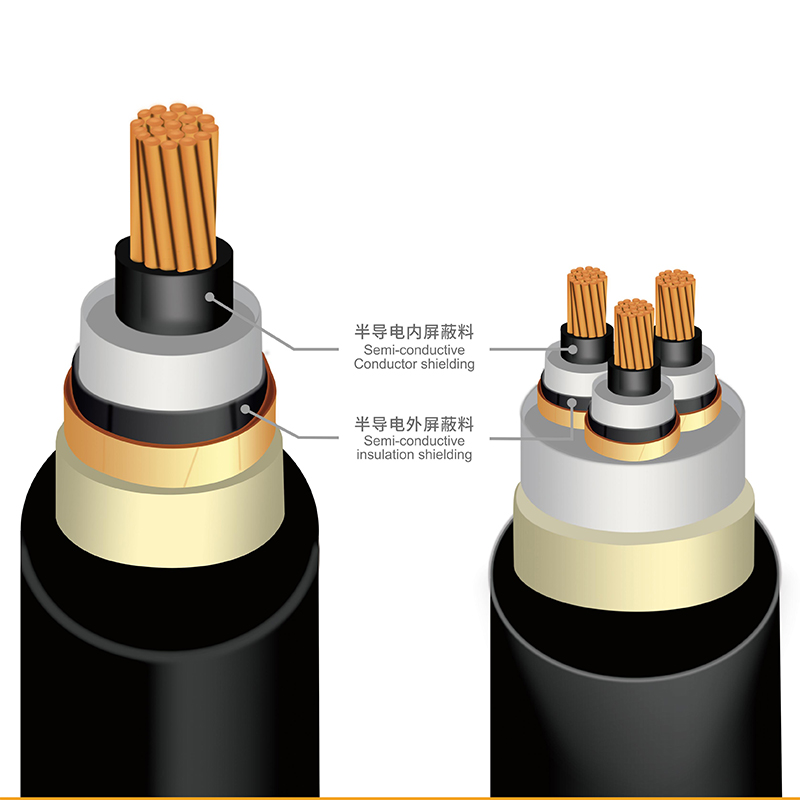
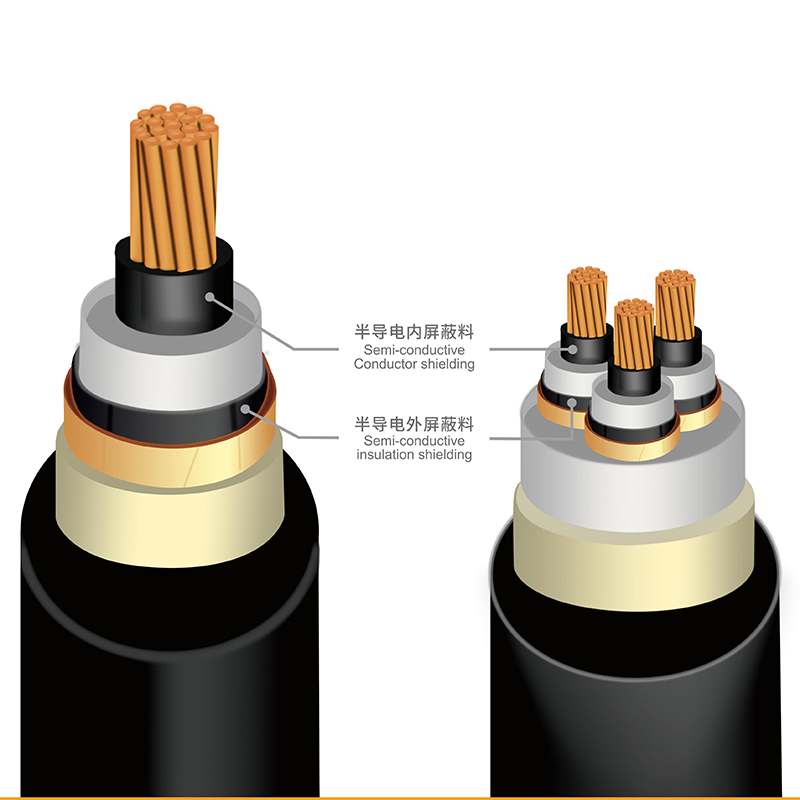
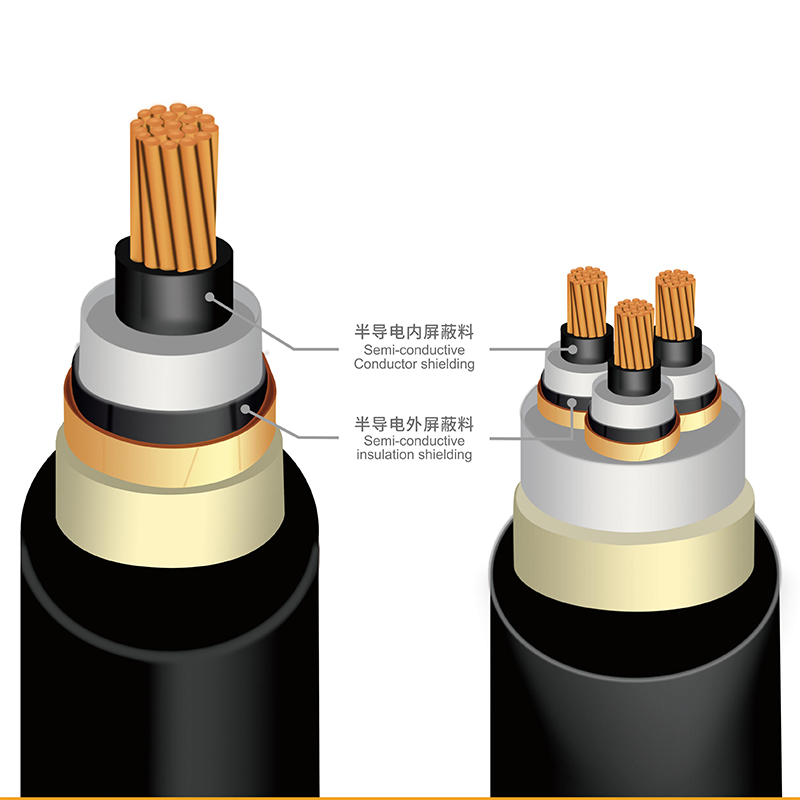
Most medium- and high-voltage cables use two semi-conductive layers rather than one, and some designs add a third conductive layer over the core. Each has a different duty, and each therefore demands a different balance of properties from the compound.
| Layer | Position in the cable | Main duty |
|---|---|---|
| Conductor shielding | Between conductor and insulation | Fills strand gaps and smooths the inner surface |
| Insulation shielding | Between insulation and metallic screen | Prevents voids and manages outer field stress |
| Conductive sheath or bedding | Over the cable core, where used | Adds conductive, flame-retardant protection |
The conductor shield is extruded directly over the stranded conductor, so it must flow into gaps that are measured in fractions of a millimetre. The insulation shield sits on the outside of the insulation and is the layer that most often decides whether a jointing team finishes on schedule, because strippability is felt by hand. The conductive sheath, where a design calls for one, looks after mechanical and flame-retardant duties on top of electrical continuity.
Once the basic chemistry is right, performance differences show up in a handful of places. These are the areas where we spend most of our development time.
Contamination and surface roughness are the two quiet enemies of high-voltage cable. A single foreign particle embedded at the interface can raise local stress far above the design value, which is why our compounds are produced on dedicated lines with tight control of filtration and handling. The smoother the extruded surface, the more uniform the field along the whole length of the cable.
Conductor shields are generally expected to stay bonded. Insulation shields may be bonded or strippable depending on the jointing method and the preference of the cable maker. Strippable grades have to release with a predictable, moderate force across a wide range of temperatures, because a cable installed in a cold trench in winter must still be workable by hand.
A compound that performs beautifully at 20 metres per minute is of little use on a fast extrusion line. Melt flow, die swell and scorch behaviour all have to line up with the actual running conditions of the customer's equipment.
Volume resistivity must stay within specification across the whole service temperature range, not just at 20 degrees Celsius. All of our products are halogen-free and are formulated to comply with RoHS and comparable requirements.
Our range is organised by voltage class and by shielding position, with variants tuned for specific production methods and strippability expectations. A quick tour through the power cable shield compounds families shows how the logic fits together.
High-voltage work leaves the least room for error. Compounds for these cables are judged on cleanliness, surface smoothness and long-term stability under sustained field stress, and the requirements tighten further as transmission moves towards higher voltages.
Our HJ0901 is a semi-conductive conductor and insulation shielding compound developed for high-voltage power cable, and HJ0281 serves as a flame-retardant conductive polyolefin sheath for the same class of cable.
 HJ0901 Semi-conductive Conductor and Insulation Shielding Compound for HV Power Cables [SuUltra-clean bonded conductors and insulation shielding materials for high-voltage cables have a rated voltage of up to 132kV, and are characterized by ultra-cleanlines...View Product →
For lower voltage classes, throughput and handling often weigh as heavily as electrical performance. SIOPLAS-method thermoplastic compounds are a common choice because they process cleanly and simplify the overall line set-up. HJ0283 is a thermoplastic shielding compound for the SIOPLAS method, while HJ0286 offers the same processing route in a strippable version.
![HJ0286 [Strippable] Thermoplastic Shielding Compound for Sioplas Method](https://www.hjcheme.com/hjcheme/2026/01/30/6-bmCA.jpg) HJ0286 [Strippable] Thermoplastic Shielding Compound for Sioplas MethodThermoplastic strippable insulation shielding material is a non-cross-linked thermoplastic semi-conductive composite material developed specifically for silane cross-l...View Product →
HJ0286 [Strippable] Thermoplastic Shielding Compound for Sioplas MethodThermoplastic strippable insulation shielding material is a non-cross-linked thermoplastic semi-conductive composite material developed specifically for silane cross-l...View Product →
Conductor shields for medium-voltage cable are offered as a family rather than a single grade. HJ0301 covers standard medium-voltage conductor shielding, HJ0302 is designed for both insulation and conductor shielding in the same cable, HJ0304 is tuned for fast production lines, and HJ0305 is intended for copper-related conductor applications.
 HJ0302 Semi-conductive Insulation And Conductor Shielding Compound for MV Power Cables [BoCross-linked bonded insulating shielding material is a semi-conductive composite material designed for medium voltage extruded insulated cables with a rated voltage no...View Product →
The insulation shield family follows a similar logic with different priorities. HJ0601 is the base grade, HJ0602 is the easy-strip version, HJ0603 is the super version, HJ0604 is built for fast lines, and HJ0605 addresses copper conductor applications. Choosing between them usually comes down to the jointing method, the line speed and how the installation crew prefers the shield to behave.
Compounding semi-conductive material is a balancing act. Carbon black and other fillers have to be distributed evenly enough that resistivity does not drift from batch to batch, while the polymer itself must not be overworked to the point where processing behaviour suffers. Our plant in Jiangyin covers more than 30,000 square metres and runs 13 production lines dedicated to semi-conductive shielding compounds, with an annual capacity of 62,000 tonnes of medium- and high-voltage grade material. A new plant area came into operation in 2017.
Quality work is not only a laboratory exercise. We hold three granted invention patents and forty granted utility model patents, with further applications in progress, and we have taken part in standards work since 2007, when JB/T 10738-2007 was drafted. In 2018 we contributed to State Grid standards for 220 kV high-voltage shielding compounds, and our products obtained UL certification in 2015. In 2023 the company was recognised as a national-level specialised and sophisticated "little giant" enterprise, and we self-report a domestic market share above 40 percent in our segment.
That history matters to a cable maker for a simple reason: consistency is the property customers actually buy. Volume resistivity, pellet cleanliness, moisture control and extrusion behaviour all have to repeat from the first drum to the thousandth.
When you evaluate a semi-conductive compound for a new cable design, these are the points that most often decide the outcome.
It also helps to read up on how the industry treats related questions, such as the trade-offs between bonded and strippable designs covered in our notes on medium-voltage conductor shield standards.
None of this is complicated in principle, but the details are where cables are won and lost. If you are working on a new design or trying to solve a stubborn extrusion problem, our technical team is happy to sit down with your process data and suggest a starting grade. That conversation usually saves more time than any data sheet can.
![HJ0302 Semi-conductive Insulation And Conductor Shielding Compound for MV Power Cables [Bonded Insulation Grade]](/hjcheme/2026/01/30/1-oGlm.jpg "HJ0302 Semi-conductive Insulation And Conductor Shielding Compound for MV Power Cables [Bonded Insulation Grade]")
![HJ0603 Semi-conductive lnsulation Shielding Compound for MV Power Cables [Super Clean Grade]](/hjcheme/2026/01/30/1-h8nu.jpg "HJ0603 Semi-conductive lnsulation Shielding Compound for MV Power Cables [Super Clean Grade]")
![HJ0604 Semi-conductive Insulation Shielding Compound for MV Power Cables [Fast Line Speed Grade]](/hjcheme/2026/02/04/1.jpg "HJ0604 Semi-conductive Insulation Shielding Compound for MV Power Cables [Fast Line Speed Grade]")
![HJ0901 Semi-conductive Conductor and Insulation Shielding Compound for HV Power Cables [Super Clean and Smooth]](/hjcheme/2026/02/04/5-zhjG.jpg "HJ0901 Semi-conductive Conductor and Insulation Shielding Compound for HV Power Cables [Super Clean and Smooth]")
![HJ0305 Semi-conductive Conductor Shielding Compound for MV Power Cables [Copper oxidation resistance Grade]](/hjcheme/2026/01/30/2-ybjb.jpg "HJ0305 Semi-conductive Conductor Shielding Compound for MV Power Cables [Copper oxidation resistance Grade]")



