Welcome to visit the website of HJ Polymer China Co., Ltd. ---Semi-conductive Compound Industry Solutions


 中文简体
 Français
 عربى


Welcome to visit the website of HJ Polymer China Co., Ltd. ---Semi-conductive Compound Industry Solutions

Content
Most copper versus aluminum discussions begin and end with a data sheet: conductivity, density, price per tonne. Those figures are real, and they settle a lot of legitimate questions in distribution and industrial wiring. Once a cable moves into the medium voltage and high voltage range, though, the metal is only half of the decision. The other half sits in a layer a few tenths of a millimetre thick, right where the conductor meets the insulation. That layer is the semiconductive shielding compound, and it is usually what decides whether a cable passes its type test, survives twenty years of load cycling, and still strips cleanly during a joint on a cold morning.
Annealed copper and electrical-grade aluminum are both excellent conductors. They are simply not interchangeable at the surface, and that is where shielding compound formulation starts. Aluminum delivers roughly 61% of the conductivity of copper at the same cross-section, so an aluminum conductor needs a larger area to carry the same current. Along the way it brings a different oxide, a different expansion rate, and a different response to bending and compaction.
| Property | Annealed copper | 1350 aluminum |
|---|---|---|
| Conductivity, % IACS | 100 | About 61 |
| Density, g/cm3 | 8.9 | 2.7 |
| Thermal expansion, ppm per K | About 17 | About 23 |
| Surface oxide | Thin and weakly adherent, grows slowly | Electrically insulating and tightly adherent, forms within seconds |
| Behaviour under terminal pressure | Stable | Creeps, needs specific hardware |
| Interaction with the shield compound | Catalyses polyolefin oxidation, adhesion drifts with ageing | Oxide resists wetting, higher expansion shears the interface |
The table explains the weight and cost argument. What it does not show is why two cables with identical insulation thickness and identical voltage class can behave completely differently in service, purely because one conductor is copper and the other is aluminum.
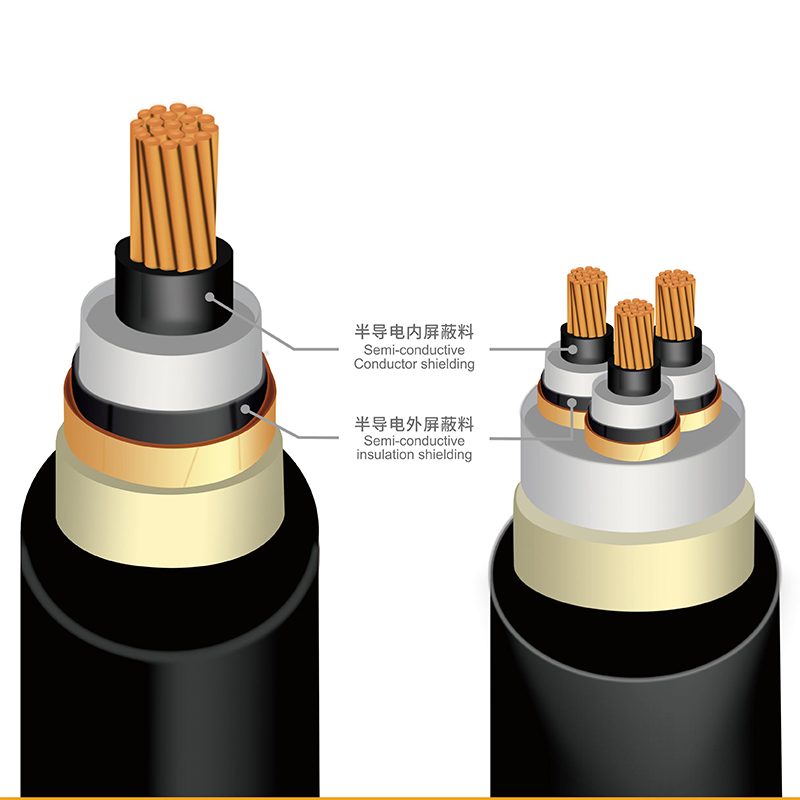
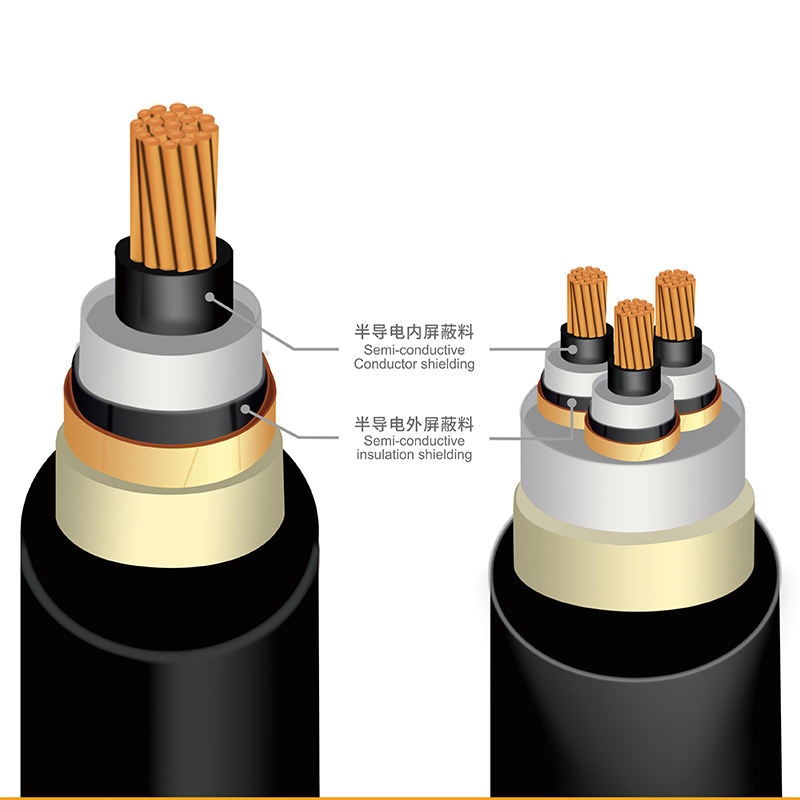
A conductor shield has three jobs, and all three are interface jobs.
The shield spreads the electric field across the conductor surface so that no individual strand carries a concentrated stress. Strand gaps, burrs and compaction marks are all field enhancements, and the compound has to smooth them electrically. The surface smoothness of the shield matters as much as the smoothness of the metal underneath it.
Bonded or strippable, the compound has to wet the metal, fill the interstices between strands, and stay filled through thermal cycling, bending and the mechanical loads of installation. A void at the conductor interface is a partial discharge site, and partial discharge is what ages insulation from the inside out.
This is where copper and aluminum part company. Copper is not chemically passive: copper ions catalyse the thermal oxidation of polyolefins, so a compound in contact with copper needs a stabiliser system that a compound in contact with aluminum may not require. Aluminum behaves differently again, because its oxide grows within seconds of exposure to air, does not conduct, and clings tightly to the metal beneath.
Work with copper long enough and the same two problems come back. The first is oxidation at the interface, accelerated by heat and by any residue left on the strand surface. The second is adhesion that drifts: a shield that bonds well on day one can become almost impossible to strip after a few years at 90 °C conductor temperature, which turns a routine joint into a repair job.
Copper-oriented compounds are therefore formulated around a specific peel target rather than maximum adhesion, with a stabiliser package matched to the catalytic activity of the metal and a rheology that lets the melt wet each strand without starving the conductor screen during co-extrusion.
 HJ0305 Copper-Oxidation-Resistant Conductor Shield CompoundCopper-facing semi-conductive shield grade for up to 36 kV cables, formulated to limit conductor oxidation and support stable joint behavior over time.View Product →
Grades such as HJ0305 exist for exactly this reason: same voltage class as a general-purpose conductor shield, different surface chemistry underneath. Choosing between them is not a marketing decision, it is a decision about how the cable will behave at the joint ten years from now.
Aluminum asks different questions. Its oxide does not conduct, so the compound has to displace air and oxide-affected surfaces at every strand contact, and it has to do so at a melt viscosity that still fills compacted strand profiles. Its thermal expansion is roughly a third higher than copper's, which means a loaded cable repeatedly shears the interface between metal and shield, and any weak spot becomes a void over a few thousand cycles.
Aluminum is also softer. Over-tight tooling, aggressive pulling, or a shield that cures too hard can deform the outer strands, and a deformed conductor is a rough conductor electrically as well as mechanically. Compounds designed for aluminum tend to pair high filler loading for conductivity with enough flexibility to follow that movement instead of fighting it.
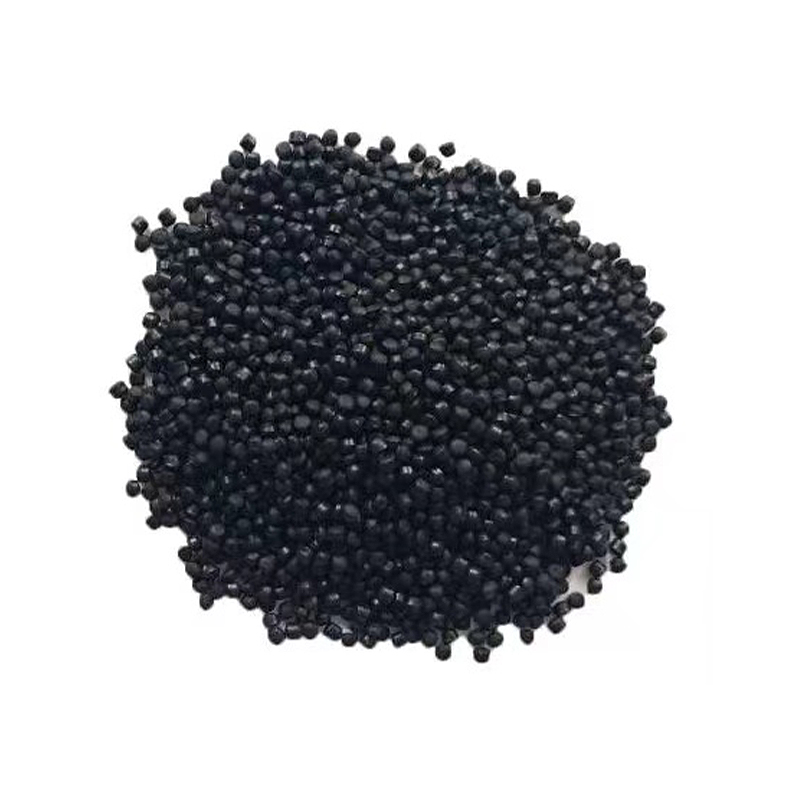
 HJ0301 General-Purpose Medium-Voltage Conductor ShieldBonded semi-conductive shield for up to 36 kV cables, combining conductivity, extrusion flowability and thermal stability for aluminum conductor designs and jointing expectations.View Product →
A general-purpose medium voltage conductor shield such as HJ0301 is the usual starting point for aluminum conductor designs, with the exact grade then adjusted for strand construction, line speed and the peel behaviour the jointing crew expects.
Conductor shield, insulation and insulation shield are extruded together through a triple head, and the three melts have to behave as one process. If the conductor shield is too viscous it will not fill the strand interstices; if it is too fluid it will thin at the tip and leave the high points of the conductor nearly bare. On fast lines the window narrows further, because residence time in the head and in the curing section is shorter and scorch safety becomes a production constraint rather than a laboratory note.
 HJ0304 Fast-Line-Speed Conductor Shield CompoundCross-linked semi-conductive shield for high-output up-to-36 kV cable lines, supporting speeds up to 10 m/min and large conductor sections with anti-scorch processing.View Product →
That is the reasoning behind fast-line grades such as HJ0304: the chemistry is tuned for the time and temperature profile of a high-output line, not for a laboratory press.
Most medium voltage specifications converge on a handful of measurable properties: volume resistivity of the shield, surface smoothness, void and protrusion limits under the microscope, hot-set behaviour, and peel strength measured both at room temperature and at elevated temperature. The pass or fail line is rarely about the metal. It is about whether the compound held its adhesion through ageing, and whether the interface stayed free of voids after the cable was thermally cycled.
Bonded and strippable designs sit at opposite ends of that trade-off, and the choice is usually made by the jointing practice of the utility rather than by the compound supplier. We wrote a longer explanation of how those two families differ and where the standards draw the line in this note on bonded and strippable MV conductor shields.
When a cable maker or a utility asks us to recommend a grade, the conversation covers the same ground almost every time. Working through these questions first saves a surprising amount of trial extrusion:
If the answers point to a medium voltage conductor shield, the range is best reviewed as a family rather than as isolated grades. The MV conductor shielding compound range is laid out that way, with the differences between grades stated plainly.
Copper and aluminum will keep competing on cost, weight and conductivity, and they should. But the comparison only becomes useful for cable design once the shielding compound enters the picture, because the interface is where the electric field, the metal chemistry and the mechanical movement of a loaded cable all meet at once.
We have been formulating semiconductive compounds for power cable since 2002, from a plant in Jiangyin with thirteen dedicated production lines and an annual capacity of 62,000 tonnes. Along the way we took part in the JB/T 10738-2007 industry standard and in the State Grid 220 kV high voltage shielding compound standard, and we have spent much of that time watching how small differences at the conductor interface turn into large differences in the field. If you are weighing copper against aluminum on a project, send us the conductor construction and the jointing method. The metal choice is yours; the interface is what we do.